Write AI UGC ads as product demonstrations or clearly identified presenter scripts, not invented customer experiences: describe supported features, show the product, and remove any claim that the speaker bought, used, or benefited from it unless that experience is real and documented. An AI-generated presenter does not establish customer experience, and a disclosure does not make an invented testimonial truthful.
TL;DR
Write AI UGC ads around verified product facts, not fictional purchases, personal results, or customer testimonials.
Planegraph supports generation and editing; customer evidence must come from your own records.
Choose presenter-led demonstrations for product explanations; reserve testimonials for documented experiences with appropriate permission.
Review scripts, generated footage, captions, and usage rights before publishing.
How do you write AI UGC ads without inventing customer testimonials?
Separate what the product does from what a customer experienced. Your script can explain the first without claiming the second.
For production, Planegraph combines generation with editable output. Keep the evidence behind each advertising claim separate from the production tool.
Use this sequence for your 2026 creative brief:
Collect product facts. Identify the source for every feature, instruction, and benefit you intend to mention.
Choose the speaker's role. Use a presenter or narrator unless you have an actual customer's documented account.
Write observable actions. Describe what the viewer can see rather than inventing a personal history.
Match visuals to claims. Remove generated details that imply unsupported product behavior or results.
Review the finished export. Check speech, captions, imagery, disclosures, and permissions together.
The distinction is straightforward: a presenter can explain a feature without pretending to be a satisfied buyer.
Why this matters
UGC-style production borrows the visual language of personal recommendations: direct-to-camera delivery, casual framing, and conversational speech. That style becomes misleading when the script supplies a fictional purchase, problem, or result and presents it as someone's experience.
Realistic delivery is not evidence. A convincing voice and natural-looking presenter do not substantiate the words being spoken.
For a 2026 campaign, keep the conversational format but remove the fabricated biography. You can still open with a product question, show an application, explain a feature, or address a purchasing concern.
Choose the format before writing the hook
Not every ad with a person speaking needs to be a testimonial. Choose a format based on the evidence you have, not the visual style you want.
Presenter-led explanation
Best for: Explaining verified product features
Strength: Does not require an invented customer backstory
Limitation: The script must avoid implying personal use
Product demonstration
Best for: Showing observable actions or a real interface
Strength: Connects statements to visible evidence
Limitation: Generated footage needs checking against the actual product
Documented customer testimonial
Best for: Communicating a real person's experience
Strength: Preserves an attributable customer account
Limitation: Requires evidence, permission, and faithful treatment of the original statement
A presenter-led explanation is the practical default when you lack customer material. A demonstration works when you can accurately show the action. A testimonial belongs in the script only when the underlying experience exists.
Do not blend these formats casually. Placing a genuine product shot under an invented personal success story does not turn the story into a supported claim.
Build an evidence-first script in 5 steps
Use 5 steps to take the script from product information to an editable production brief. The objective is a traceable claim, not merely believable dialogue.
Product facts
Create a working sheet with 3 columns: claim, source, permitted wording. Sources can include approved product documentation, current instructions, actual interface captures, or customer material you have permission to use.
Keep each claim narrow. Evidence that a tool contains an editing control supports describing that control; it does not establish that every customer finishes a project faster.
Mark unsupported lines for removal rather than asking the generator to make them sound more credible. Treat missing evidence as a writing constraint.
Speaker role
State the role in the brief before generating dialogue: presenter, narrator, employee, or actual customer. Do not let a conversational prompt silently turn a presenter into a buyer.
Give the writing assistant explicit boundaries:
Describe only the supplied product facts.
Do not invent ownership, purchases, personal use, or outcomes.
Do not create customer quotations or review summaries.
Flag any sentence that needs evidence not included in the brief.
These instructions guide drafting. They do not replace a human review of the output.
Observable actions
Write around actions the finished ad can accurately show. An illustrative presenter line is: Here is how the editing control changes the layout. Use it only when that control and action exist.
Contrast that with a fictional line such as I switched last month and my sales doubled. That sentence asserts a personal history and a measurable result. Remove it unless both are supported by the real speaker's documented experience and the claim has been approved.
Do not disguise an unsupported outcome as a question. Asking whether a product will transform every buyer's results still introduces a promise your evidence may not support.
Visual evidence
Map each spoken claim to the footage that supports it. Use actual interface captures for interface behavior and accurate product references for appearance.
Generated imagery needs its own review. Check packaging, labels, controls, textures, and depicted actions against the real product. Attractive footage is not enough if it changes what the product is or does.
Separate an illustrative setting from evidence of performance. A generated scene can establish context without proving that a product caused the result shown.
Final review
Run 2 review passes: a claim review and an audiovisual review. In the first, inspect every statement and implication; in the second, inspect what viewers actually hear and see.
Read the captions independently. Then watch without captions. An unsupported statement can survive in a subtitle, a voiceover revision, or an end card after the main script has been corrected.
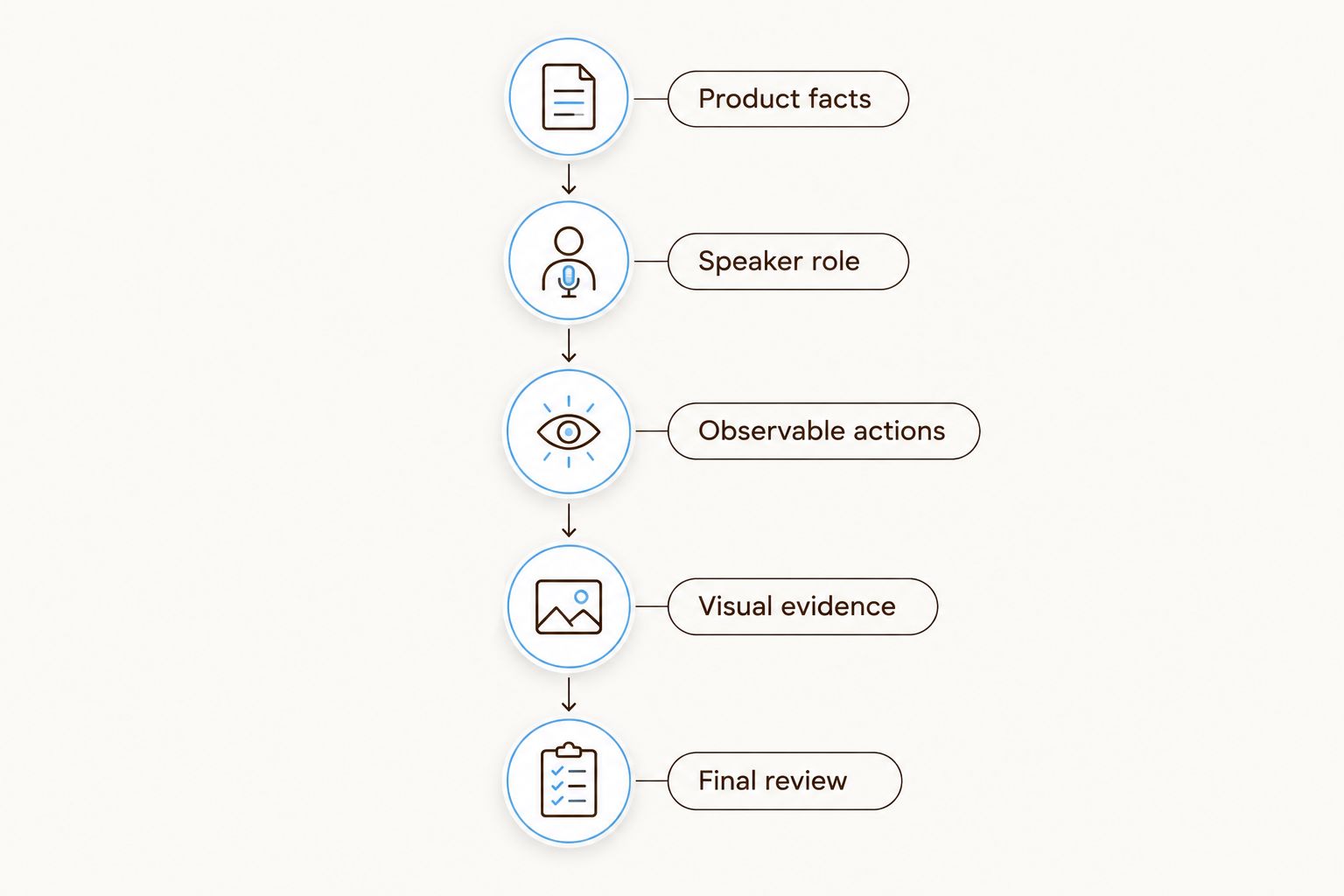
Check both the spoken claim and the visual evidence before approving the export.
Why AI UGC ad scripts need different levels of review
The review burden depends on what the ad asserts. Use these factors to decide where to spend attention in your 2026 production process:
Personal experience: A first-person purchase or usage story needs an actual experience behind it.
Outcome claims: Statements about performance need evidence that supports the stated outcome and its scope.
Visual alteration: Generated product details need comparison with the real item or interface.
Source material: Customer footage and statements introduce permission and editing boundaries.
Version changes: New hooks, voiceovers, crops, and captions can change the meaning of an approved ad.
Keep review proportional to the claim. A factual explanation of an interface control differs from a promise about what a buyer will achieve.
Avoid treating an approved script as approval for every subsequent version. The final arrangement of footage and speech determines the message viewers receive.
Can an AI presenter speak in the first person?
An AI presenter can speak in the first person without claiming customer experience, but the surrounding wording must make the role clear. A process statement such as I'll show you the layout controls differs from a personal endorsement such as I use this every day.
The first describes the presentation. The second asserts an ongoing relationship with the product.
For your 2026 scripts, inspect verbs such as bought, tried, switched, noticed, and recommended. Each can introduce a personal history that the brief never established.
An AI disclosure addresses the synthetic presentation; it does not substantiate the experience being described. Keep both questions separate during review.
Can you adapt a real customer review into an AI UGC ad?
You can consider adapting a documented customer review when your permissions cover the intended use and the adaptation preserves the original meaning. Do not assume permission to quote text also covers synthetic speech, likeness, paid distribution, or substantial rewriting.
Keep the original review beside the proposed script. Compare the strength of the claim, any qualifications, and the identity attributed to the speaker. Removing a limitation can change a faithful account into a broader endorsement.
The production record should connect the source material, permission, approved wording, and final asset. That connection makes managing UGC usage rights part of script approval rather than a separate filing task after the ad is finished.
If the permission does not cover the proposed adaptation, change the format instead of inventing consent. Use a presenter-led product explanation without impersonating the reviewer or presenting a paraphrase as a direct quotation.
Keep generation and editing in the same review loop
Planegraph is best for marketers producing AI UGC ads who need generation and editable finished output in one workspace. Its full-featured video timeline and layered image canvas support a workflow that continues beyond the first generated asset.
AI assistants can make requested changes, while manual controls support final adjustments. Use that combination to correct wording, replace an inaccurate visual, and inspect the resulting composition rather than accepting the initial generation as finished.
Planegraph's Prism workflow includes planning, checking, and retries. Set the task around a factual brief and inspect the output after revisions; a retry is a production action, not proof that a claim is true.
The platform also includes a library of thousands of Meta ads that AI can remix around a product using models such as Nano Banana, alongside built-in avatars, pose guides, and reference content. Treat those materials as creative inputs, not evidence of customer satisfaction or permission to reproduce another advertiser's claims.
The limitation remains explicit: Planegraph's AI UGC ad workflow does not replace your product evidence, customer permissions, or approval process. Follow the product-link-to-finished-ad workflow with those records attached to the brief.
What should your approval brief contain?
For a 2026 handoff, give the editor a compact record that survives beyond the initial prompt. Include the approved script, evidence references, speaker role, required disclosures, permitted source assets, and prohibited claims.
Add a version note that identifies what changed. A new opening can introduce a personal endorsement even when the rest of the ad remains unchanged; a tighter crop can remove context that previously qualified the message.
Ask the reviewer to approve the exported asset, not just the document. Listen for added dialogue, inspect visible text, and compare the depicted product with the source references.
Keep creative approval and claim approval distinct. A client liking the hook does not establish that the hook is supported. Route unresolved claims back to the person responsible for the evidence rather than polishing them into the final cut.
FAQ
How do I write AI UGC ads without fake testimonials?
Write AI UGC ads as presenter-led explanations or accurate product demonstrations using supported facts. Remove invented purchases, personal use, and customer outcomes.
Can an AI avatar say it uses my product?
Do not script an AI avatar as a real customer with an invented usage history. Give the presenter a clear explanatory role and describe supported product capabilities instead.
Does an AI disclosure make a fictional review acceptable?
An AI disclosure does not make a fictional customer experience truthful. The underlying purchase, use, or outcome claim still needs support.
Can I turn a customer review into a synthetic voiceover?
Check that your permissions cover the proposed synthetic adaptation before producing it. Preserve the review's meaning and do not assume permission for text also covers voice, likeness, or paid advertising.
What's the safest script format when I have no customer reviews?
Use a presenter-led product explanation or an accurate demonstration rather than a testimonial. Build the script around verified features and observable actions.
What should I check before publishing an AI UGC ad in 2026?
Check the final video's claims, speaker role, product accuracy, captions, disclosures, and source permissions. Review the export itself because editing can change the meaning of an approved script.
One last thing
Search the final script for I, my, and since. These words are not automatically wrong, but they often reveal a personal history hidden inside otherwise factual product copy.
Replace unsupported biography with an observable action. You retain the conversational delivery without manufacturing a customer.